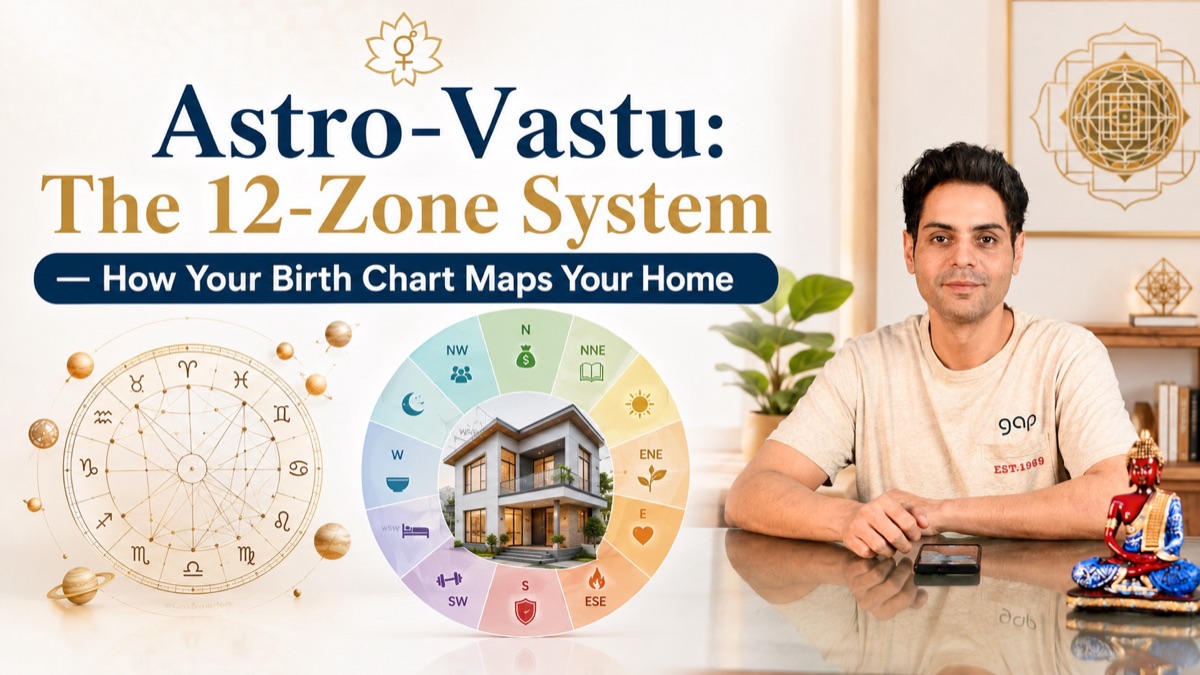
Most people think of Vastu Shastra as a fixed set of rules — north is good, south-west should be heavy, kitchen must face east, and so on. These are useful generalizations. But they miss something fundamental: your home does not exist in isolation. It exists in relationship with YOU.
The system developed and taught by Vastu Guruji Rana Sikander (RS) through his Astro-Vastu Masterclass curriculum takes a radically different approach. Instead of applying generic directional rules to every building, this method reads your personal birth chart — your Astro-Patri — and extracts from it a precise map of 16 directional Vastu zones that are uniquely calibrated to you. This map tells you which zones in your home will amplify your wealth, which will energise your relationships, which will support your health, and — critically — which zones carry the energetic signatures of struggle, loss, or hidden difficulty.
This is Assignment 1 of the Astro-Vastu methodology. It is the foundation. Every advanced technique in the entire system builds on what you learn here. Master this, and the rest follows with remarkable clarity.
In standard Vedic astrology, your birth chart (Janam Kundli) shows the positions of 9 planets across 12 houses at the exact moment of your birth. In the Astro-Vastu system, Vastu Guruji RS uses a specific format of this chart — the Astro-Patri — which places special emphasis on the cusp rashis of each house rather than on the planet placements alone.
Think of a house (box) as a room with a doorway. The cusp rashi is the sign written at that doorway — it is the energetic identity of that house's threshold. In Astro-Vastu, this threshold sign is what translates into a physical direction in the real world.
The 12 cusp rashis from your birth chart produce a unique directional fingerprint. No two people have exactly the same fingerprint (unless born at the same time and place). This is why Astro-Vastu personalises Vastu analysis at an individual level — something no classical text has done with this degree of precision.
Before we look at the 12 boxes individually, you must understand the five foundational rules that govern the entire system. Violate or ignore any of these rules, and your zone analysis will be incorrect.
Rule 1 — Cusp Rashi = Vastu Zone
The zodiac sign (rashi) written at the cusp of each house in the birth chart directly indicates the Vastu directional zone in the building. The sign is the zone. Always begin here.
Rule 2 — Box Activity = Physical Space
Each box (house) governs specific life activities. The physical area of your building that falls in that box's directional zone will amplify or suppress those activities when you spend time there.
Rule 3 — Rahu-Ketu Displacement Rule
Rahu and Ketu have no rashi of their own. When they own Box A's cusp rashi but sit in Box B, Box A's activities are experienced in Box B's cusp rashi directional zone. Always check Rahu/Ketu before finalising any zone.
Rule 4 — Box 4 = Building's Facing Direction
The cusp rashi of the 4th house (Box 4) tells you the main entrance direction that is most energetically aligned with the chart owner. Use this as a verification check when selecting or analysing a property.
Rule 5 — Birth Home = Pregnancy Home (Not Hospital)
When identifying the birth home for an Astro-Vastu analysis, use the home where the mother lived during her pregnancy — where she conceived and spent the majority of the nine months. The hospital or nursing home where delivery occurred is NOT the birth home. The energetic imprint forms during gestation, not at the moment of birth.
The Rahu-Ketu Rule — Explained in Depth
This rule confuses most beginners, so let us break it down precisely. In classical Vedic astrology, Rahu and Ketu are shadow planets — they don't "own" a rashi the way Mars owns Aries. However, in some Astro-Vastu formulations, the cusp rashis of certain boxes can be assigned to Rahu or Ketu through their nodal axis governance.
The operative principle is this: Rahu and Ketu are physical wanderers — they show where the energy actually flows, not where the sign says it should go. So if Box 5 (children, hobbies, solutions) has a Cancer cusp (indicating NNE zone), but Ketu — who is associated with that axis — sits in Box 11 (income, friends), then the experiences of Box 5 will physically manifest in Box 11's Vastu zone rather than Box 5's stated NNE zone.
The practical implication: always locate Rahu and Ketu in the chart FIRST, then check whether they affect any cusp rashis through ownership or proximity. If yes, redirect those boxes' activities to the zones where Rahu/Ketu physically sit.
The 4-Degree Orb Rule
Each house cusp sits at a specific degree within a rashi. If that degree falls within 4° of the boundary with the next rashi, both rashis — and therefore both directional zones — may be considered active for that box.
For example: if Box 3's cusp is at Gemini 27°, it is within 3° of Cancer (which begins at 0° Cancer = 90° of the ecliptic). In this case, both the NNW zone (Gemini) and the NNE zone (Cancer) are active for Box 3 activities. Vastu Guruji RS teaches that in such cases, the space between those two directional zones — or either zone — will activate Box 3 life themes.
This is why some boxes in the reference table have two directions listed: it reflects the dual-zone phenomenon produced by the orb rule.
The Birth Home Rule — Why It Matters
One of the most commonly misunderstood aspects of Astro-Vastu is which home to analyse as the "birth home." In Vastu Guruji RS's teaching, the birth home is where the mother conceived the child and spent the majority of her pregnancy. This is the home whose directional energies imprinted on the child during gestation.
The hospital or nursing home where delivery took place is not the birth home. Even if the mother moved from one flat to another during pregnancy, the flat where she spent the most time — particularly the first trimester — carries the greatest Astro-Vastu significance.
This matters because when analysing why someone has a particular relationship with a type of space or direction, the birth home analysis must use the correct starting address. Using the hospital address produces entirely wrong results.
Classical Vastu Shastra works with 8 directions (N, NE, E, SE, S, SW, W, NW) and sometimes 16 sub-directions. The Astro-Vastu system used by Vastu Guruji RS operates with 16 directional zones, giving far more precision. Each of the 12 rashis maps to one or two of these zones.
Each box (house) below shows its life themes, its cusp rashi, its corresponding Vastu zone, and the practical implications for your building. Click/tap any box to expand its full detail.
1
Box 1 — Self, Identity, Physical Body, Personal Belongings
Cusp Rashi: Aries → Vastu Zone: East (E6)
East / E6
▾
Box 1 is the first house of the birth chart — the Ascendant (Lagna). It represents the chart owner as a person: their physical body, personality, the way they present themselves to the world, and their personal identity. In practical terms, it is the house of "self."
What activities belong in Box 1's zone?
- Personal items storage — your wardrobe, your personal desk, your meditation space
- Mirror placement — the East zone of the home is excellent for a full-length mirror
- Morning routines — eastern light at sunrise activates Box 1's vitality energy
- Health-related activity — Box 1 rules the physical body; East-facing exercise space is powerful
Vastu-Vastu Guruji Insight
Vastu Guruji RS teaches that the East zone of a building, when properly activated, directly strengthens the chart owner's personal vitality and charisma. If the East zone is blocked, cluttered, or has a toilet, the chart owner's health and self-confidence will suffer disproportionately — even if other zones are perfect. Clear and energise the East first.
● East Zone Mars energy Self & Identity
2
Box 2 — Wealth, Family, Valuables, Speech, Food
Cusp Rashi: Taurus → Vastu Zone: NW (W7)
NW / W7
▾
Box 2 governs accumulated wealth, family relationships (especially the immediate family you were born into), valuable possessions, the quality of speech and voice, and food and eating habits. It is the house of material security and family roots.
What activities belong in Box 2's zone?
- Safe or locker placement — North-West is traditionally strong for valuables storage
- Family dining area — eating together in the NW zone strengthens family bonds
- Cash/jewellery storage — the NW zone activates Box 2's wealth accumulation energy
- Family photographs — keeping family memories in the NW corner reinforces ancestral connection
Vastu Guruji RS Insight
RS teaches that when Box 2's NW zone is activateed by regular, intentional family activity — particularly sharing meals — the chart owner experiences a noticeable strengthening of family relationships and financial stability. The NW zone governs both inflow (family support) and stored wealth simultaneously, making it doubly important to protect and energise.
3
Box 3 — Siblings, Courage, Communication, Short Travel
Cusp Rashi: Taurus/Gemini → Vastu Zone: NW + NNW (Dual Zone)
NW + NNW
▾
Box 3 covers siblings, short journeys, written communication, courage, efforts, and how you present yourself in professional environments. It is the house of initiative, boldness, and close collaborations.
Why Two Zones?
Box 3 carries a natural dual-zone quality in the Astro-Vastu system. Depending on the exact cusp degree, the active zone may lean NW (Taurus) or NNW (Gemini), or both may be active simultaneously when the 4° orb rule applies. Vastu Guruji RS advises treating the entire NW-to-NNW arc as Box 3's domain when the cusp falls near the Taurus-Gemini boundary.
What activities belong here?
- Home office or study desk facing NW — activates professional presentation energy
- Communication devices (phone, laptop) kept in the NW zone
- A sibling's room in the NW area of the home
- Books and written materials stored in the NW sector
4
Box 4 — Main Entrance, Education, Mother, Vehicles, Property
Cusp Rashi: Gemini → Vastu Zone: NNW
NNW
▾
Box 4 is one of the most important boxes in Astro-Vastu because it directly determines the ideal main entrance direction of the building. It governs home, mother, education, vehicles, property ownership, and the feeling of emotional security and comfort.
The Facing Direction Rule
If someone's Box 4 cusp rashi is Gemini, the building that will serve them best has its main entrance facing NNW. If their current building faces a different direction, there is an energetic misalignment between their chart and their property — and this misalignment will consistently produce feelings of restlessness, educational obstacles, or problematic relationships with property.
What activities belong in Box 4's zone?
- The main door / main entrance of the building — facing NNW
- Study room or library — education is a core Box 4 theme
- Mother's room — the home of the mother figure in the household
- Vehicle parking or garage in NNW area of the plot
5
Box 5 — Children, Hobbies, Intelligence, Romance, Solutions
Cusp Rashi: Cancer → Vastu Zone: NNE (Rahu-Ketu Rule applies)
NNE ⚠ RK
▾
Box 5 is the house of intelligence, creativity, children, romance, hobbies, and the ability to find solutions to problems. It is also connected to speculative investments (stock market, gambling) and entertainment. This box has a special Rahu-Ketu flag in the Astro-Vastu system.
⚠ Rahu-Ketu Rule — Box 5 Alert
In the Astro-Vastu system, Box 5 with a Cancer cusp is one of the houses most susceptible to Rahu-Ketu displacement. Always verify: where is Rahu or Ketu placed in the chart? If Ketu (associated with the Cancer axis in certain house systems) sits in a different box — say Box 9 or Box 11 — then Box 5 activities will manifest in that box's directional zone, not in NNE.
What activities belong here?
- Children's bedroom or play area in NNE zone
- Creative workspace — art studio, music room, hobby space
- Entertainment area — TV, games room
- Romance and intimacy — placing bedroom in NNE when Box 5 is Cancer activates romance
6
Box 6 — Service, Health, Daily Work, Disputes, Enemies
Cusp Rashi: Leo → Vastu Zone: ENE
ENE
▾
Box 6 governs daily routines, service occupations, health and illness (especially chronic or recurring conditions), workplace conflicts, debts, and the ability to overcome obstacles and opposition. It is the house of effort, service, and resilience.
What activities belong here?
- Kitchen — cooking is a form of daily service; ENE kitchen supports health
- Bathroom or health-related items (medicines, first aid)
- Home gym or exercise equipment — Box 6 rules physical effort and the body's endurance
- Servant quarters or domestic help's room
- Filing and paperwork for disputes, insurance, legal matters
Vastu Guruji RS Caution
A bedroom in the Box 6 zone can attract health challenges or workplace conflicts to the occupant. RS advises against sleeping in Box 6 zones unless the chart owner has very strong 6th house planetary support. Use this zone for active, transient activities — not for rest.
7
Box 7 — Spouse, Partnerships, Public Relations, Business
Cusp Rashi: Virgo/Libra → Vastu Zone: North + WSW (Dual)
N + WSW
▾
Box 7 is the house of relationships, partnerships, marriage, business deals, public image, and staff. It represents the "other" — anyone with whom you enter into a formal relationship or agreement. In Astro-Vastu, it carries a dual-zone signature similar to Box 3.
What activities belong here?
- Reception area or waiting room in businesses — North zone for public-facing activity
- Spouse's personal belongings and workspace in North or WSW zone
- Contract signing area — place a desk in the North or WSW for partnership agreements
- Guest bedroom — guests are a form of "7th house relationship"
- Staff or employees' working area
Vastu Guruji RS Insight
The North zone (Virgo) and WSW zone (Libra) together form Box 7's dual domain. For business owners, keeping the reception or client-meeting space in the North sector has a measurable positive effect on business relationships. For married couples, energising the WSW zone with the couple's shared items strengthens the marriage bond.
8
Box 8 — Hidden Things, Inheritance, Transformation, Secrets
Cusp Rashi: Scorpio → Vastu Zone: SW (S7)
SW / S7 ⚠
▾
Box 8 is one of the most complex and important houses in the entire system. It governs hidden matters, inheritance, sudden events, transformation, occult knowledge, chronic illness, and the experience of death and renewal. In Vastu terms, it rules spaces that are concealed, behind curtains, or deliberately kept private.
⚠ 8th and 12th Box Warning
Vastu Guruji RS specifically teaches that the directional zones corresponding to Box 8 and Box 12 bring weakness, pain, and problems when regularly occupied. The SW zone (Box 8) is the zone of transformation, yes — but transformation through struggle. Sleeping or working primarily in the SW zone attracts Box 8 experiences: hidden obstacles, sudden setbacks, inheritance disputes, or health crises.
What to do with Box 8's zone?
- Use SW zone for storage of items that are heavy and permanent — it absorbs Box 8's dense energy
- Master bedroom in SW is acceptable for elders (Box 8 energy matches the stage of life) — not ideal for young people
- Avoid kitchen, study, or business work in SW zone
- Keep SW zone grounded, heavy, and least frequently used for active work
9
Box 9 — Luck, Religion, Higher Education, Guru, Long Journeys
Cusp Rashi: Scorpio/Sagittarius → Vastu Zone: SW + NE (Dual)
SW + NE
▾
Box 9 is the house of divine grace, fortune, spiritual wisdom, relationship with the guru, long-distance travel, and higher education. It is considered the most auspicious trine house in Vedic astrology — the house of Dharma.
What activities belong here?
- Prayer room or pooja space — NE is the most sacred zone in classical Vastu and Box 9 confirms this
- Meditation corner in NE — activates the guru and divine grace energy
- Library for religious texts, philosophy books
- The head's direction while sleeping — head toward SW, feet toward NE is traditionally auspicious
The SW-NE Axis
The dual zone of Box 9 creates a SW-NE axis in the building. This is the axis of wisdom and transformation — SW holds what is completed and stored (Box 8), while NE holds what is aspired toward and blessed (Box 9). Vastu Guruji RS teaches that keeping this axis clear of clutter produces a constant flow of fortunate energy through the home.
10
Box 10 — Career, Status, Authority, Height, Prosperity
Cusp Rashi: Sagittarius → Vastu Zone: NE
NE
▾
Box 10 is the zenith of the chart — the house of career, professional achievement, social status, authority, government dealings, and public reputation. Whatever stands tallest in the building and in life is Box 10 energy.
What activities belong here?
- Stairs or upper floors — "height" is a literal Box 10 symbol; stairs in the NE activate career growth
- CEO or head of household's office
- Trophies, awards, certificates — display career achievements in the NE zone
- The tallest furniture or structure should be in NE/SW — not blocking NE light
Vastu Guruji RS — Career Activation
RS teaches a specific activation: place a photo of your highest career aspiration or your mentor figure in the NE corner of your workspace. The NE zone — ruled by Sagittarius-Jupiter — is the zone of expansion, vision, and benevolent authority. Energising it with intention amplifies Box 10 results faster than any other intervention.
11
Box 11 — Income, Gains, Friends, Social Life, Fulfillment
Cusp Rashi: Capricorn → Vastu Zone: SSE / South (S6)
SSE / S6
▾
Box 11 is the house of income, gains, social network, friendships, parties, wish fulfillment, and all forms of incoming abundance. If Box 10 is the effort, Box 11 is the reward. It governs how money flows IN to the chart owner.
What activities belong here?
- Social gathering area — the SSE or South zone for parties, celebrations, friend gatherings
- Income-generating activity — a sales desk or business counter in the SSE zone activates Box 11
- Wish board or vision board — place Box 11 manifestation tools in the South zone
- Bank statements, income records — store financial gain documents in this zone
SSE / South Nuance
Box 11's zone spans both SSE and the broader South sector depending on the exact cusp degree. Vastu Guruji RS designates this as S6 (South Zone 6). The Saturn-Capricorn energy of Box 11 means gains come through discipline and consistency — not luck. The zone rewards regular, sustained activity more than one-time gestures.
12
Box 12 — Loss, Foreign Travel, Shopping, Sleep, Hidden Expenses
Cusp Rashi: Aquarius → Vastu Zone: West (W6)
West / W6 ⚠
▾
Box 12 is the house of foreign countries, isolation, sleep, meditation, expenditure, hidden losses, charitable giving, and liberation. It governs what goes OUT — spending, losses, and the dissolving of boundaries. In Vastu, this is the zone of endings and release.
⚠ Box 12 Warning — Like Box 8
Vastu Guruji RS places Box 12's West zone in the same warning category as Box 8's SW zone. Spending significant time in the West zone (W6) activates Box 12 themes: unexpected expenses, feelings of isolation, disconnection, foreign-related complications. This does not make the zone inherently bad — it means its energy must be understood and used correctly.
What activities fit the West zone?
- Bedroom for restful sleep — Box 12 rules sleep and isolation; a West-zone bedroom can actually support deep sleep if other factors align
- Meditation or spiritual retreat corner — Box 12 is the house of moksha and liberation
- Storage for items going out of the home (donations, returns)
- Foreign-related documents, passports, visa files
A quick-lookup reference for all 12 boxes — print or bookmark this for your Astro-Vastu analysis sessions.
| Box | Life Themes | Cusp Rashi | Vastu Zone | Lord Planet | Notes |
|---|---|---|---|---|---|
| 1 | Self, identity, body, personal items | Aries | East (E6) | Mars | — |
| 2 | Wealth, family, valuables, speech, food | Taurus | NW (W7) | Venus | — |
| 3 | Siblings, courage, communication, short travel | Taurus → Gemini | NW + NNW | Venus / Mercury | Dual zone (orb) |
| 4 | Home, mother, education, vehicles, main entrance | Gemini | NNW | Mercury | Determines main door direction |
| 5 | Children, hobbies, intelligence, romance, solutions | Cancer | NNE | Moon | ⚠ Rahu-Ketu rule applies |
| 6 | Service, health, daily work, disputes, enemies | Leo | ENE | Sun | Avoid sleeping here |
| 7 | Spouse, partnerships, public relations, staff | Virgo → Libra | North + WSW | Mercury / Venus | Dual zone (orb) |
| 8 | Hidden things, inheritance, secrets, transformation | Scorpio | SW (S7) | Mars / Ketu | ⚠ Zone of weakness — avoid active use |
| 9 | Luck, religion, higher education, guru, long journeys | Scorpio → Sagittarius | SW + NE | Mars / Jupiter | Dual zone — NE is sacred corner |
| 10 | Career, status, authority, height, prosperity, stairs | Sagittarius | NE | Jupiter | Place staircase & career symbols here |
| 11 | Income, gains, friends, parties, fulfillment | Capricorn | SSE / South (S6) | Saturn | Social and income activity zone |
| 12 | Foreign travel, shopping, sleep, hidden expenses, loss | Aquarius | West (W6) | Saturn | ⚠ Zone of loss — use for sleep/meditation only |
Now let us put the system into practice. Here is the step-by-step method taught by Vastu Guruji Rana Sikander for applying Assignment 1 to any birth chart and any building.
You need the chart with the exact house cusp degrees — not just planet positions. The KP (Krishnamurti Paddhati) chart format used by Vastu Guruji RS shows cusp degrees precisely. Enter the person's birth details (date, time, place) into a KP-format chart generator. Confirm the Ascendant and all 12 house cusps.
Write down the rashi (zodiac sign) at the cusp of each box from 1 to 12. For example: Box 1 = Aries, Box 2 = Taurus, Box 3 = Gemini 2°, Box 4 = Cancer, Box 5 = Leo, etc. This is your personal directional map.
Look at where Rahu and Ketu are placed in the chart. Check if any cusp rashi's sign lord is effectively displaced by Rahu or Ketu. If Box 5 cusp is Cancer but Ketu sits in Box 11, mark Box 5 activities as manifesting in Box 11's zone (SSE/South).
For every cusp that falls within 4° of the next sign boundary, mark it as a dual-zone cusp. For example: Box 3 cusp at Gemini 28° is 2° from Cancer — so Box 3 has both NNW (Gemini) and NNE (Cancer) as active zones.
Take Box 4's cusp rashi and find its Vastu zone. Compare it to the actual facing direction of the building. If they match — the building is energetically aligned. If they don't match — note the misalignment and advise the client accordingly.
Draw or mark the 16-zone directional grid on the building's floor plan. Assign the chart's zone map to the physical spaces. Note which rooms fall in which boxes. Identify any problematic placements (e.g., bedroom in Box 8 SW zone, toilet in Box 1 East zone).
Always flag Box 8 (SW) and Box 12 (West) zones as areas that require careful management. These zones, when occupied for active work or sleep by the primary chart owner, will reliably produce the negative themes of those houses: hidden struggles (Box 8) and energy / financial drain (Box 12).
Based on the zone map analysis, prepare specific recommendations: which rooms to reassign, which zones to energise with specific activities, which zones to protect or leave unstimulated. Vastu Guruji RS emphasises that even small changes — moving a desk from a Box 12 zone to a Box 11 zone — can produce significant real-world shifts within 3–6 months.
Vastu Guruji RS places particular emphasis on the 8th and 12th house zones in every Astro-Vastu consultation. While all 12 zones have their role, these two zones carry an inherently challenging quality that must be respected.
Box 8 (SW zone — Scorpio): The eighth house governs transformation through difficulty. The SW zone in a building, when used as the primary workspace or when a child sleeps there, activates hidden obstacles, unexplained health issues, sudden financial setbacks, and complex inheritance or legal disputes. This is not superstition — it is a consistent pattern observed in thousands of Astro-Vastu consultations by RS and his students.
Box 12 (West zone — Aquarius): The twelfth house governs expenditure, isolation, and what flows out. The West zone (W6), when used as a workplace or business counter, consistently produces a pattern of money flowing out faster than it comes in — even when earnings are strong. Box 12 energy dissipates and disperses; it cannot hold or accumulate.
The corrective is not to seal off these zones or panic about them. It is to use them correctly: storage, rest, meditation, and spiritual practice in Box 8 and Box 12 zones; active work, income generation, and relationship activity in Box 10, Box 11, Box 7, and Box 1 zones.
Personalisation is the Foundation
No two people have the same Astro-Vastu zone map. Generic Vastu rules are starting points. Your birth chart gives you a uniquely precise map. Use that map — not generic rules — for serious analysis.
Always Check Rahu-Ketu First
Before finalising any zone assignment, locate Rahu and Ketu in the chart. These shadow planets redirect energy from the stated zone to wherever they physically sit. Skipping this check produces wrong results.
Box 4 is Your Building Compass
The 4th house cusp rashi is your compass for property selection. If Box 4 says NNW and the building faces East — there is a fundamental misalignment that will produce recurring discomfort regardless of other enhancements.
Respect Box 8 and Box 12
These two zones will always bring challenge when used for active occupation. Work with their natural energy (storage, rest, spiritual use) rather than against it. Fighting Box 8 and 12 energy drains effort without reward.
Frequently Asked Questions
What is Astro-Vastu and how is it different from traditional Vastu Shastra?
What are the 12 boxes in Astro-Vastu?
What is the Rahu-Ketu rule in Astro-Vastu?
What is the birth home rule in Astro-Vastu?
How do I find the facing direction of my building using Astro-Vastu?
Ready to Map Your Home with Astro-Vastu?
Get your free Vedic birth chart to identify your personal Astro-Vastu zones. Know exactly which directions in your home or office are aligned with your wealth, health, relationships, and career — and which are working against you.
Generate Free Kundli →