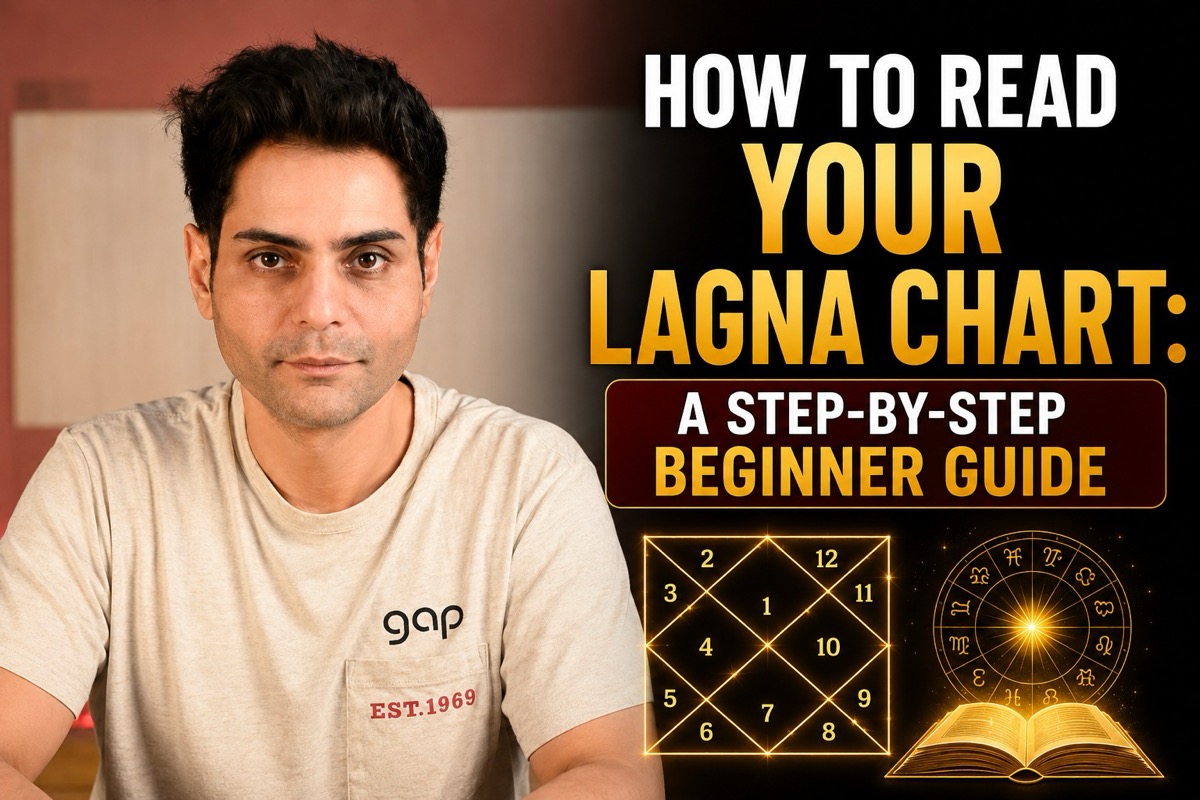
Your kundli (birth chart) looks like a complex geometric diagram filled with numbers, symbols and abbreviations. For most people who've never studied astrology, it's completely unreadable. But it doesn't have to be. With the right framework, you can extract meaningful information from your own chart within minutes.
This guide walks you through the 5 core steps of reading a Vedic lagna chart.
Step 1: Identify Your Lagna (Ascendant)
In a North Indian chart, House 1 is at the top center (the box with "1" written in it). The zodiac sign written in that box (or next to it) is your lagna sign — the ascendant.
The lagna is the most personal and sensitive point in your chart. It changes sign every ~2 hours, which is why birth time matters so much. Your lagna determines:
- Which planet is your chart ruler (lagna lord)
- Which houses are naturally favourable for you
- Your physical appearance and first impressions
- Your default approach to life
| Lagna Sign | Ruler | Core Traits |
|---|---|---|
| Aries | Mars | Bold, pioneering, athletic. Strong drive, can be impulsive. |
| Taurus | Venus | Grounded, aesthetic, patient. Values comfort and stability. |
| Gemini | Mercury | Communicative, curious, adaptable. Duality is a theme. |
| Cancer | Moon | Nurturing, intuitive, emotional. Home and family central. |
| Leo | Sun | Confident, magnetic, creative. Natural leadership. |
| Virgo | Mercury | Analytical, precise, service-oriented. Detail-focused. |
| Libra | Venus | Balanced, diplomatic, aesthetic. Partnership-driven. |
| Scorpio | Mars | Intense, investigative, transformative. Nothing superficial. |
| Sagittarius | Jupiter | Philosophical, adventurous, optimistic. Truth-seeker. |
| Capricorn | Saturn | Disciplined, ambitious, practical. Long-term planner. |
| Aquarius | Saturn | Unconventional, humanitarian, intellectual. |
| Pisces | Jupiter | Spiritual, empathetic, creative. Porous boundaries. |
Step 2: Find Your Lagna Lord and Its Position
Once you know your lagna sign, find its ruling planet (the "lagna lord"). Then look at which house that planet sits in. This is one of the most important placements in your chart.
Example: Scorpio lagna → lagna lord is Mars → Mars in 10th house → career-focused, drives the professional life, likely ambitious and possibly in a competitive field.
The lagna lord in different houses gives a broad life theme:
- 1st: Strong self-focus, direct personality
- 2nd: Wealth accumulation is a primary drive
- 4th: Home, property, and comfort are central
- 5th: Intelligence, creativity, and children are themes
- 7th: Partnerships (business or marriage) dominate
- 9th: Fortune, spirituality, foreign connections
- 10th: Career and public status are the focus
- 11th: Gains and social networking are prominent
Step 3: Locate the Three Most Important Planets
After the lagna, the three most impactful planets in your chart are:
Sun
Soul, father, career authority. The house Sun occupies shows where you seek recognition.
Moon
Mind, emotions, mother. Moon's house shows where you feel most emotionally invested.
Jupiter
Wisdom, growth, children. Jupiter's house shows where you're naturally lucky and expansive.
Step 4: Check for Strong or Weak Planets
In Vedic astrology, each planet has signs where it's especially powerful or weak:
- Exalted (Uchcha): Planet at its most powerful. Sun in Aries, Moon in Taurus, Mars in Capricorn, Mercury in Virgo, Jupiter in Cancer, Venus in Pisces, Saturn in Libra.
- Debilitated (Neecha): Planet at its weakest. The opposite signs of exaltation. Sun in Libra, Moon in Scorpio, etc.
- Own sign (Swa): Comfortable and effective. Sun in Leo, Moon in Cancer, etc.
Step 5: Read the Current Dasha Period
Even a perfectly positioned planet only gives its results during its dasha (ruling period). This is what makes Vedic astrology so precise for timing. Look at which planet's mahadasha is currently running in your chart — the themes of that planet's houses and sign will dominate your life right now.
Read Your Own Chart
Generate your free kundli and apply these 5 steps to your own birth chart.
Get Free Kundli →