Vimshottari Dasha: How Astrology Predicts When
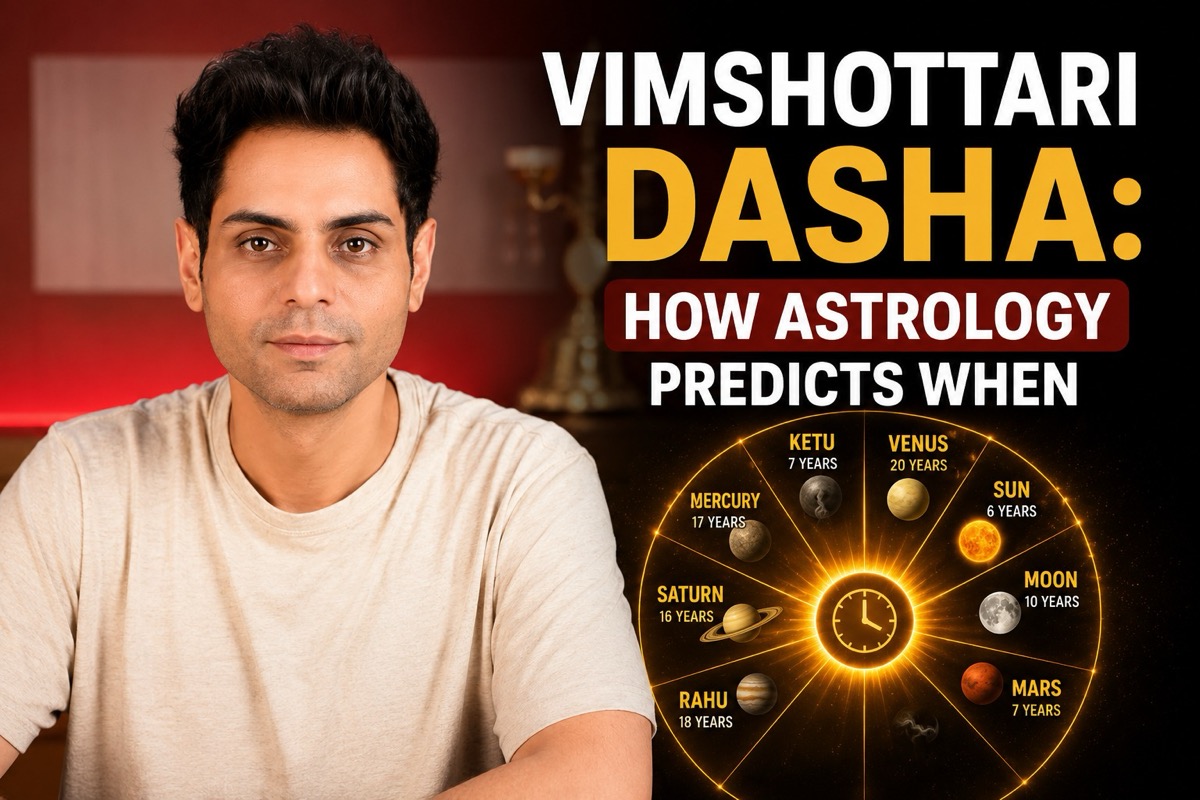
A chart shows what is promised; the dasha system shows the timing. Vimshottari Dasha is the clock of Vedic astrology — learn it and your readings gain a calendar.
Up to now we have read what a chart promises. The missing piece is when — and that comes from Vimshottari Dasha, the most widely used timing system in Vedic astrology. It divides life into planetary periods that unfold in a fixed order across a 120-year cycle. Whichever planet's period is running "switches on" the results it carries in your chart.
The nine Mahadashas and their lengths
The main periods (Mahadashas) always run in the same order, with fixed lengths totalling 120 years:
| Order | Planet | Years |
|---|---|---|
| 1 | Ketu | 7 |
| 2 | Venus (Shukra) | 20 |
| 3 | Sun (Surya) | 6 |
| 4 | Moon (Chandra) | 10 |
| 5 | Mars (Mangal) | 7 |
| 6 | Rahu | 18 |
| 7 | Jupiter (Guru) | 16 |
| 8 | Saturn (Shani) | 19 |
| 9 | Mercury (Budh) | 17 |
That is 7 + 20 + 6 + 10 + 7 + 18 + 16 + 19 + 17 = 120 years, the traditional full human lifespan.
Where does your cycle start?
Everyone runs the same sequence, but starting at a different point. The starting Mahadasha is set by the nakshatra (one of the 27 lunar mansions) your Moon occupies at birth. Each nakshatra has a planetary ruler, and that planet's dasha is already running when you are born. How far the Moon has travelled through the nakshatra decides how much of that first dasha is already elapsed.
Antardashas — the sub-periods
Each Mahadasha is divided into nine Antardashas (sub-periods), one for every planet, in the same order and proportional to their lengths. So a 19-year Saturn Mahadasha contains a Saturn-Saturn period, a Saturn-Mercury period, a Saturn-Ketu period, and so on. The Mahadasha sets the theme; the Antardasha fixes the month-to-year timing within it. Astrologers always read the pair together — e.g. "Jupiter Mahadasha, Venus Antardasha."
How to read a dasha
To judge any running period, simply analyse the dasha-lord as you would any planet from earlier lessons:
1. Dignity: is the dasha-lord exalted, in its own sign, or debilitated?
2. Placement & rulership: which houses does it sit in and rule? Those are the life areas that activate during its period.
3. Yogas & aspects: does it form a Raja or Dhana yoga, and what does it aspect? A strong yoga-forming dasha-lord brings a rising, fruitful period.
A well-placed dasha-lord delivers its promised results in its period; a weak one brings the struggles of the houses it governs. This is the bridge between a static chart and the unfolding events of a real life.
Find your current Mahadasha & Antardasha
Your free MahaJyotish kundli calculates your full Vimshottari Dasha timeline from your Moon\'s nakshatra — see which period you are living through now.
Get My Kundli →