Anatomy of a Birth Chart: How to Read a Kundli from Scratch
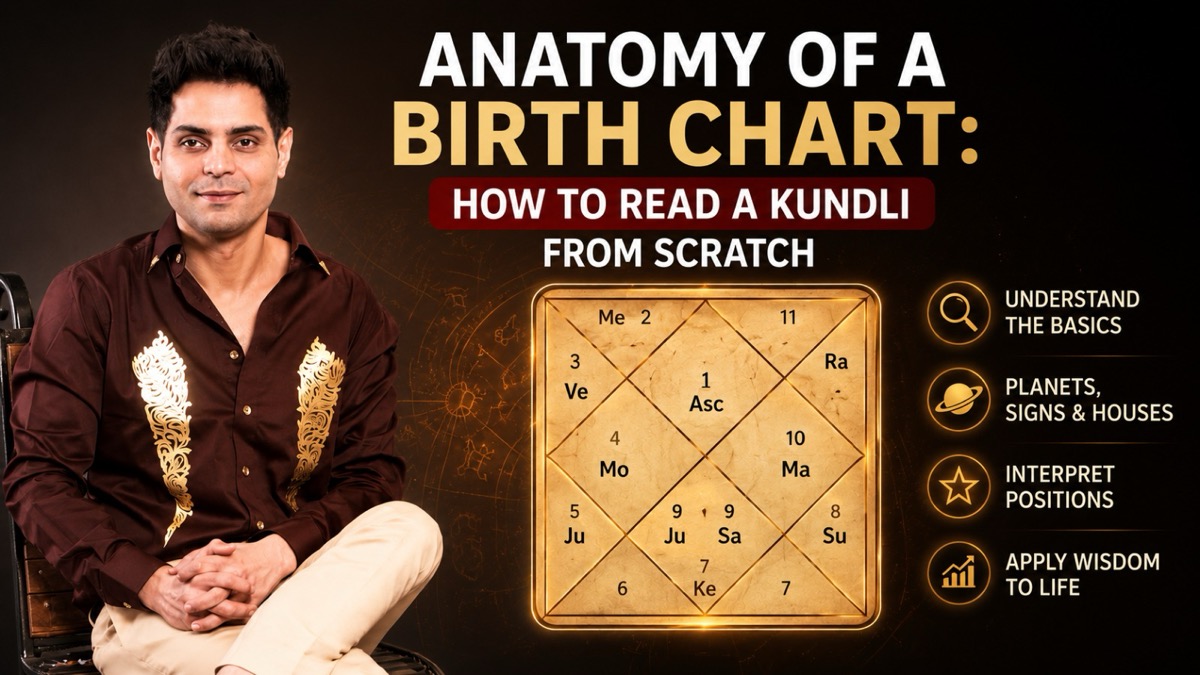
Before you can interpret a single prediction, you need to understand the four building blocks every Vedic horoscope is made of. Master these and the rest of jyotish becomes readable.
A Kundli is simply a photograph of the sky taken at the instant you were born, from the exact spot you were born. Vedic astrology (Jyotish) reads that photograph to understand who you are and how your life unfolds in time. It looks intimidating at first — lines, numbers, abbreviations — but every chart in the world is built from just four ingredients:
1. The Lagna — your reference point
The Lagna (Ascendant) is the zodiac sign that was climbing over the eastern horizon at your moment of birth. Because the Earth rotates once a day, the Lagna changes roughly every two hours — which is exactly why two babies born on the same day but a few hours apart can have very different charts.
The Lagna becomes your 1st house. Everything else in the chart is counted from it. It represents your body, your temperament, your overall vitality and the "lens" through which you meet life. Get the Lagna right and the chart is trustworthy; get the birth time wrong and the whole house structure shifts.
2. The 12 Houses (Bhavas) — the stage
The chart is divided into twelve houses, each governing a department of life. The 1st house is the self; counting onward you reach wealth, communication, home, children, health, partnership, and so on, all the way to the 12th house of loss and liberation. In the whole-sign system used in this course, the Lagna's sign is the entire 1st house, the next sign is the 2nd house, and so on around the wheel.
We will give every house its own full lesson in Part 2. For now, just hold the idea: houses are the "where" of life — the arenas where events happen.
3. The 12 Rashis — the flavour
Each house is occupied by one of the twelve rashis (zodiac signs), from Mesha (Aries) to Meena (Pisces). A sign colours whatever planet or house it touches with its element (fire, earth, air, water), its quality, and its ruling planet. Aries acts boldly; Cancer acts protectively; Capricorn acts patiently. Signs are the "how" — the style and temperament of the energy.
| Element | Rashis | Nature |
|---|---|---|
| Fire (Agni) | Aries, Leo, Sagittarius | Drive, inspiration, courage |
| Earth (Prithvi) | Taurus, Virgo, Capricorn | Stability, practicality, patience |
| Air (Vayu) | Gemini, Libra, Aquarius | Intellect, relationships, ideas |
| Water (Jal) | Cancer, Scorpio, Pisces | Emotion, intuition, depth |
4. The 9 Grahas — the actors
Finally, the Navagraha — nine "planets" that actually do the acting: Surya (Sun), Chandra (Moon), Mangal (Mars), Budh (Mercury), Guru (Jupiter), Shukra (Venus), Shani (Saturn), and the two shadow nodes Rahu and Ketu. Each graha carries its own significations — Jupiter expands and blesses, Saturn restricts and matures, Mars energises and fights. Planets are the "who" — the forces taking action on the stage of the houses, in the style of the signs.
North-Indian vs South-Indian charts
You will meet two layouts. In the North-Indian diamond chart the houses are fixed (the top-centre diamond is always the 1st house) and the sign numbers move. In the South-Indian square chart the signs are fixed in their boxes and the Lagna is marked, so the houses move. Both contain identical information — pick whichever you find easier to read.
Generate your free Kundli and follow along
Reading is easiest when you have a real chart in front of you. Create yours in seconds and keep it open as you go through this course.
Get My Kundli →